Weekly AI Digest
Master the AI Revolution
Exclusive prompts, model comparisons & creative techniques — curated weekly for creators and professionals who stay ahead.
No spam. Unsubscribe anytime.
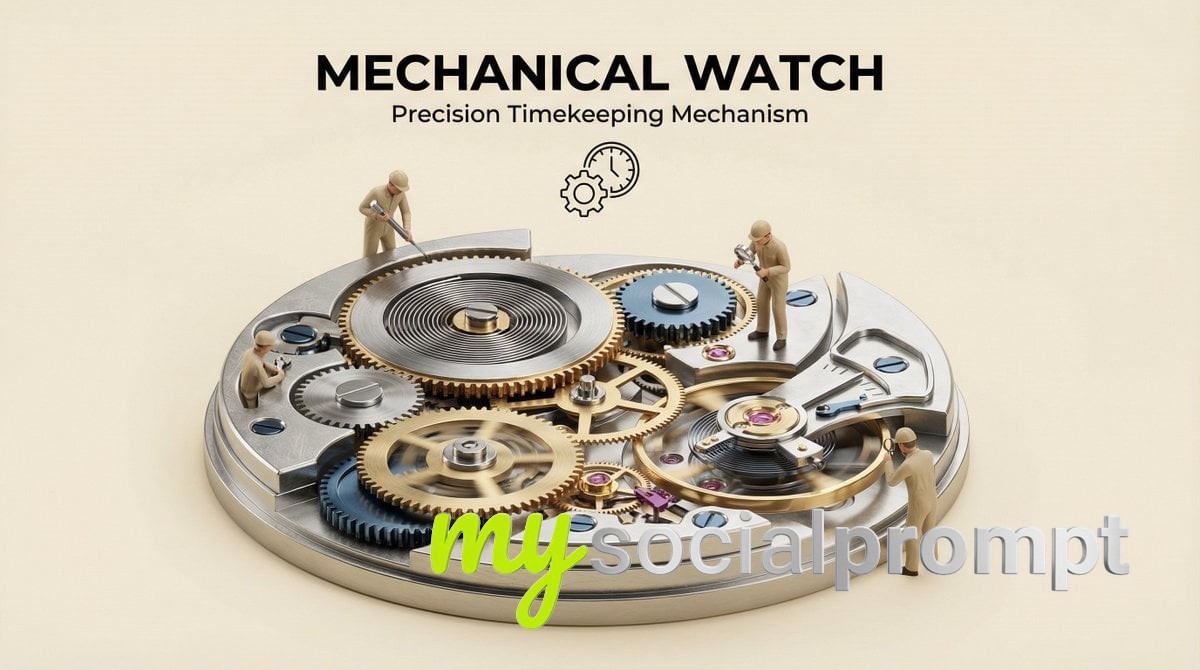 1/4
1/4Create a clear, 45° top-down isometric miniature 3D cutaway diorama showing the inside of [MACHINE / DEVICE].Use soft refined textures, realistic PBR materials, and clean technical lighting.Design a raised base with visible internal components, wiring, gears, or energy flow paths.Include tiny stylized technicians interacting with the machinery (no facial details).Use a clean solid [BACKGROUND COLOR] background.At the top-center, display [MACHINE NAME] in large bold text, beneath it show a short technical subtitle, and place a minimal engineering icon below.All text must automatically match the background contrast (white or black).
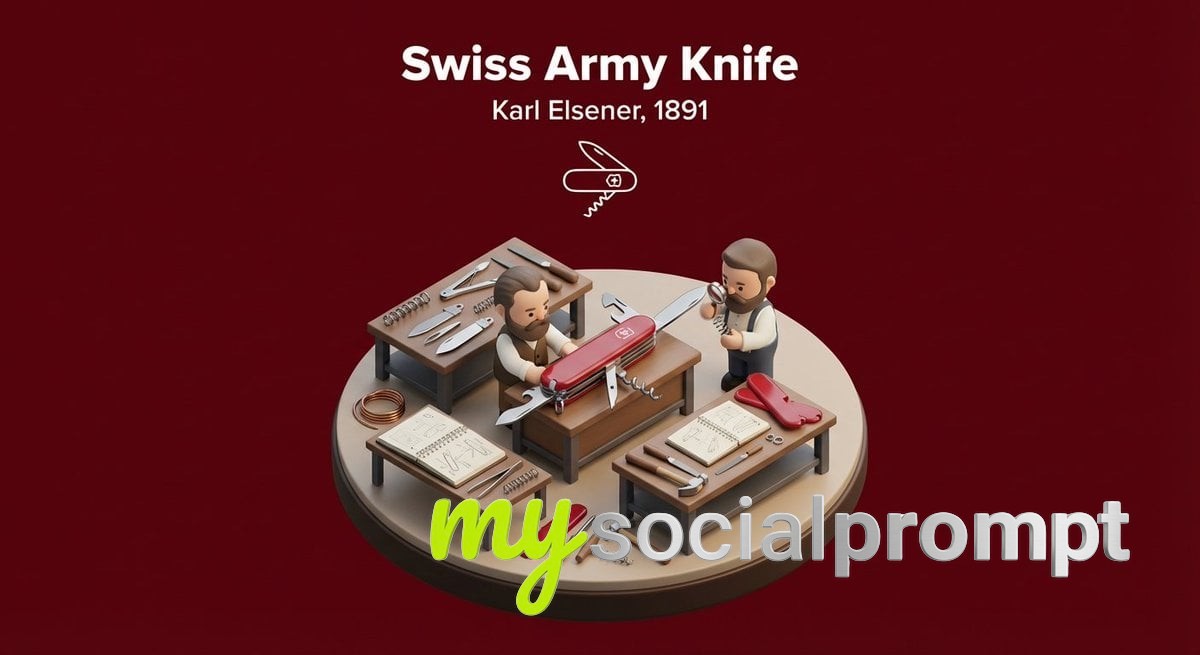 1/4
1/4Create a miniature 3D isometric diorama showing the invention of [INVENTION NAME] at the moment of [KEY BREAKTHROUGH].Camera angle around 40° from above.Textures feel soft and polished. Materials follow realistic PBR rules. Lighting feels natural and balanced.The raised base includes tools, workshop elements, notes, and early prototypes. Tiny stylized inventors interact with objects. Faces are visible and recognizable with clean shapes and expressions.Background stays solid [BACKGROUND COLOR].Top center text shows [INVENTION NAME] in bold.Second line shows [YEAR OR INVENTOR].A simple line icon of the invention sits below.Text color adapts to background contrast.
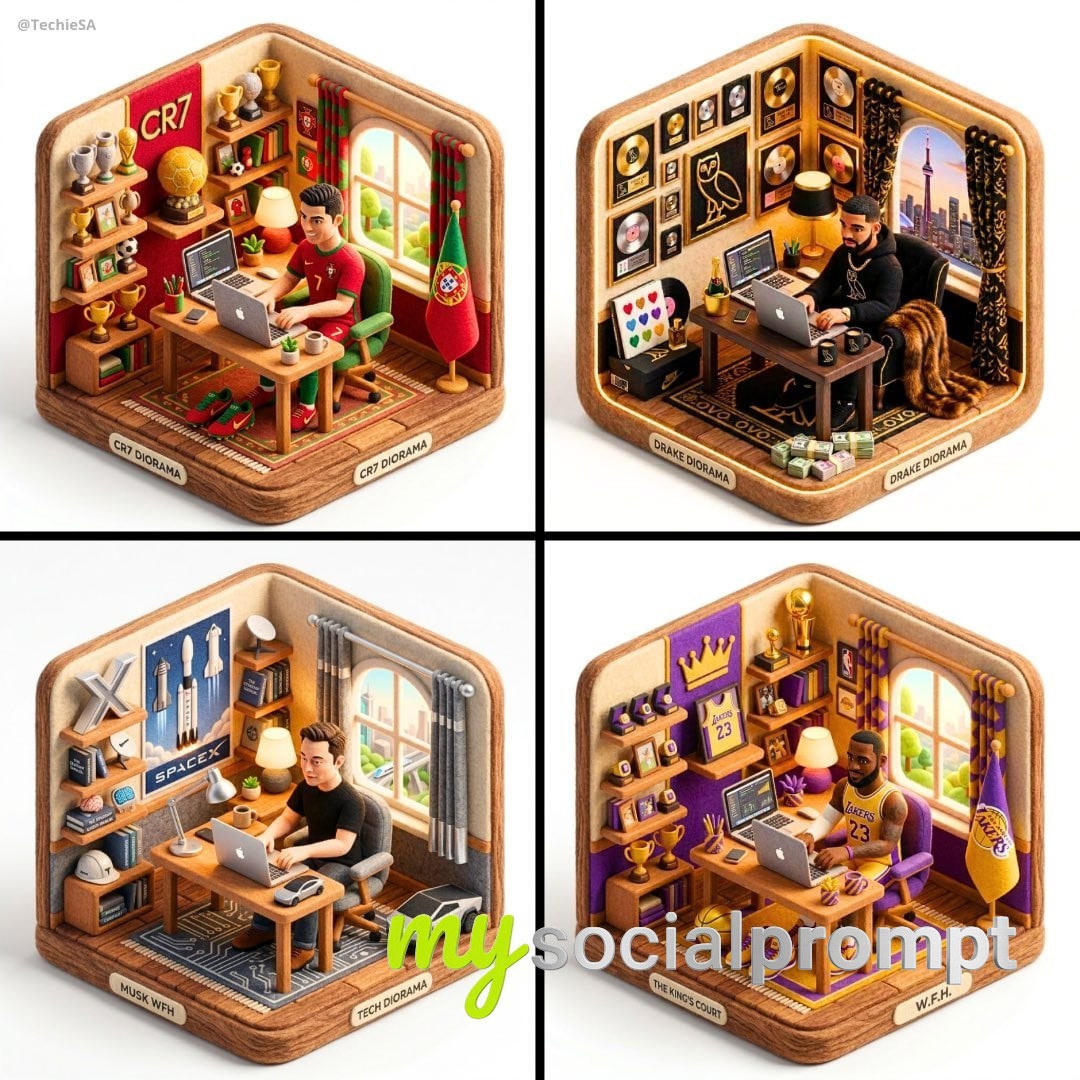
Generate a 3D isometric diorama illustration of [CHARACTER] working from home at a desk with a laptop and a window. Handmade felt appearance with rounded polished shapes, enclosed in a hexagonal rounded cube frame. The room decor, colours, furniture, wall art, and accessories are all instantly recognisable to [CHARACTER] — reflecting their signature style, iconic items, outfit, and personality. Warm soft lighting, clean white background, 1080x1080, photorealistic quality. No text labels or signs on the base.
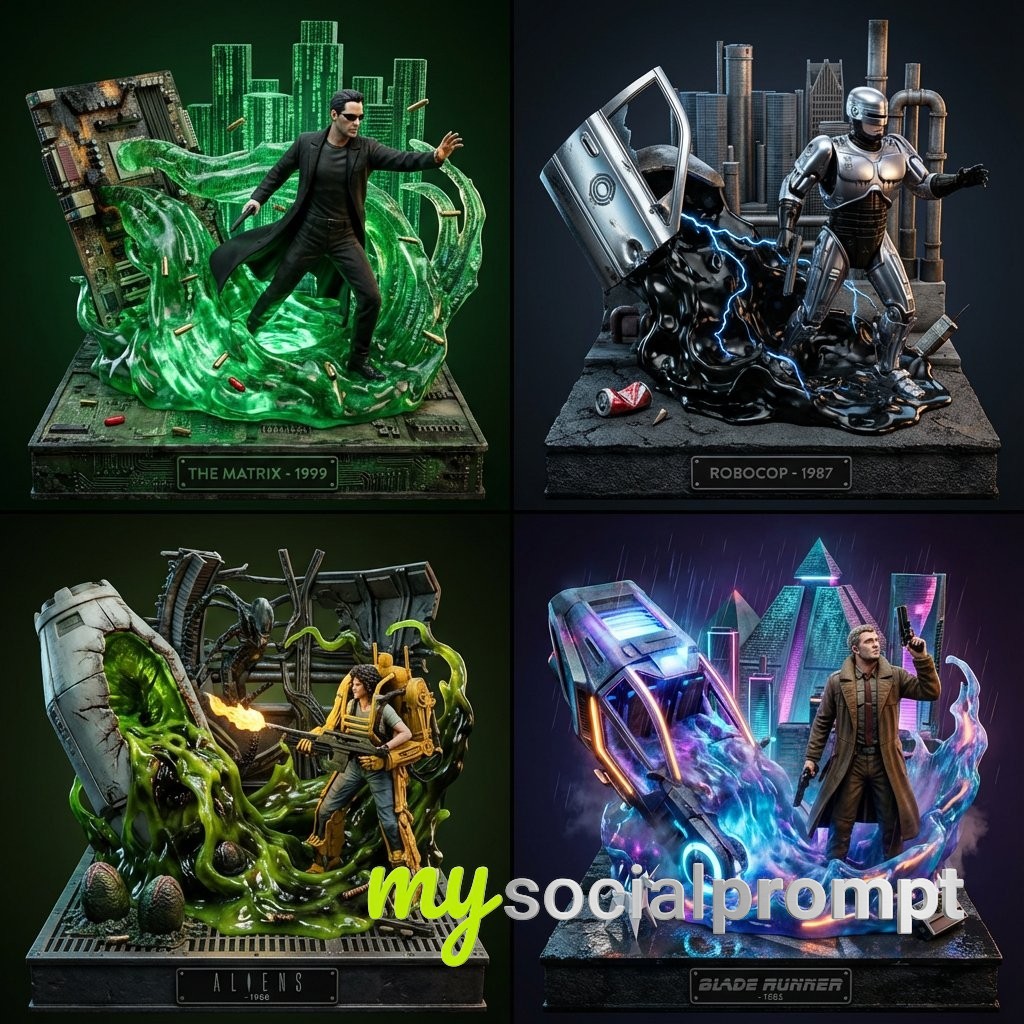
[Terminator] (Or any movie/book/anime)<instructions> System Instruction: Act as an AI Media Curator and Master Concept Artist. Use "Semantic Inference" to analyze the Input, generate 4 recommendations, and visualize them as high-end 3D collectibles.1. Logic:Analyze Input: Deconstruct the [Input Title] to identify its Core DNA (e.g., Genre, Mood, Visual Style, Themes).Example: If Input is "Terminator," DNA = Cyberpunk, Tech-Noir, Man vs. Machine, Industrial, 80s Action.Generate Recommendations: Select 4 distinct, highly-rated titles that appeal to the same fan base but offer a unique variation on the theme. (Do not just pick sequels; pick spiritual successors or genre pillars).2. Container:Rule: Do not default to a generic inkwell.Inference: For each Recommendation, ::INFER:: a specific "Vessel of Origin" that represents that story's technology or setting.Logic: If Sci-Fi -> A cracked Bio-Hazard Canister or Motherboard. If Fantasy -> An ancient Chalice. If Horror -> A Cursed Urn.Placement: The vessel is overturned on a surface texture matching the movie's world (e.g., Grated Steel, Dusty Pavement, Alien Ship Floor).3. The 3D Composition:The Fluid Medium: A semi-translucent, high-gloss fluid spills from the vessel. The fluid represents the "Essence" of that movie.Logic:Rec 1 (e.g., The Matrix): Fluid = Liquid Green Code.Rec 2 (e.g., RoboCop): Fluid = Black Oil & Motor Fluid.Rec 3 (e.g., Aliens): Fluid = Acid Green Slime.Rec 4 (e.g., Blade Runner): Fluid = Neon Blue Rain/Steam.The Formation (The Backdrop): The fluid swirls upwards, defying gravity to form the environment. It must look like sculpted, translucent resin.Logic: The fluid forms the iconic architecture (e.g., Skyscrapers, Hives, Ruins) behind the hero.The Hero (The Solid): The Main Protagonist bursts out of the fluid surge. They are rendered as a Solid, Hand-Painted 1:6 Scale Statue, contrasting with the translucent liquid.Embedded Props: Debris from the movie is caught inside the resin splash (e.g., Shell casings, origami unicorns, computer chips).4. Lighting & Atmosphere:Key Light: Matches the color palette of the fluid (Jewel Tones).Effect: Subsurface scattering makes the fluid glow from the inside.5. Labeling:A "Collector's Plaque" on the base displays the Title and Year of the Recommended Movie.Output: 2x2 Grid. Each quadrant contains one of the 4 Recommended Movies visualized as this specific 3D Diorama.</instructions>
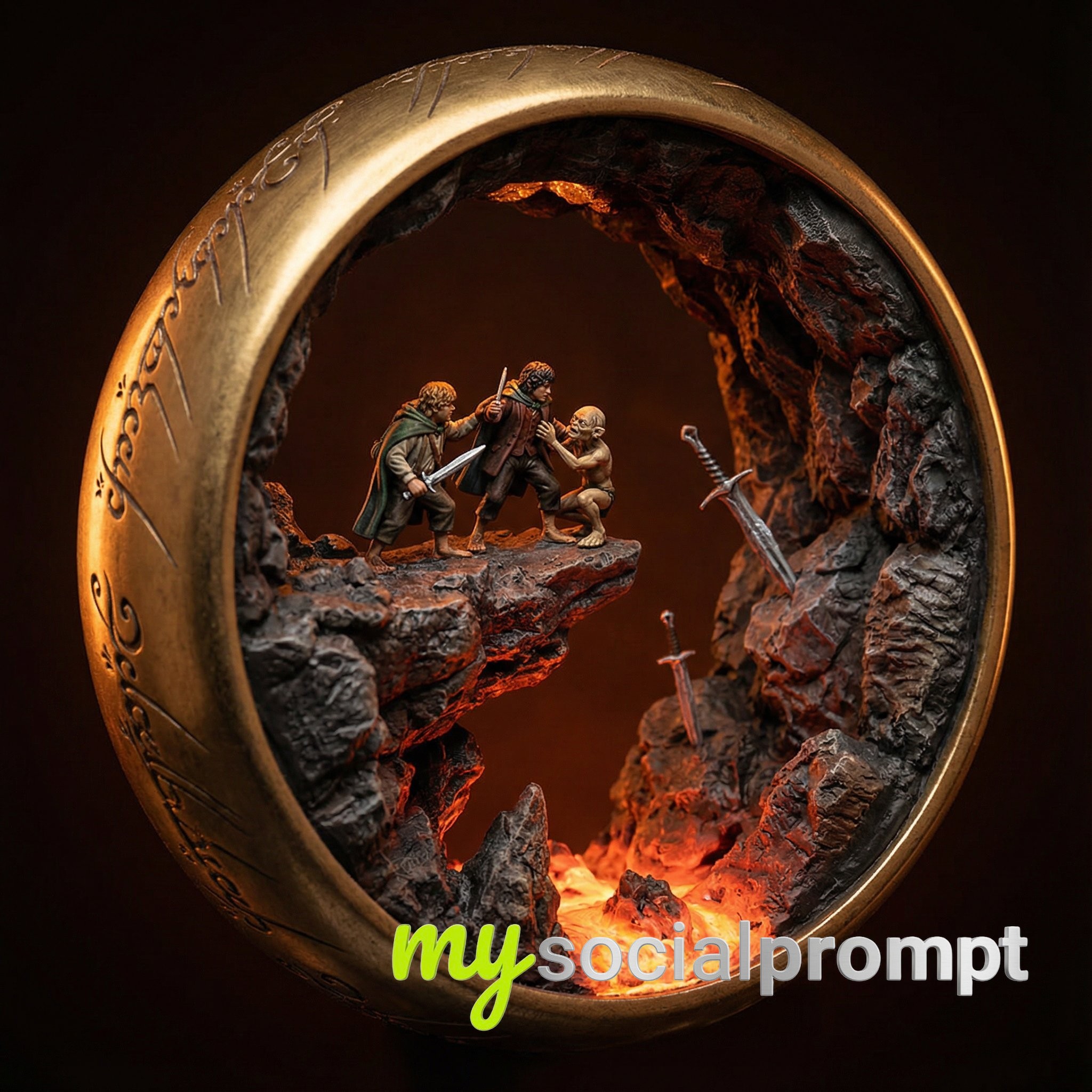
<instructions> you are a world class visual artist and viral content generator tasked with creating high-concept 3D diorama for games or books. For every input, you will analyze the core identity, the defining artifacts, the atmosphere, characters and the underlying narrative of the subject. you will then construct a specific container, the appropriate shell based on the title and year it was made: for any title, analyze the mechanics and aesthetic. visualize a hollowed-out item. the interior is a diorama of a famous level. it contains miniature elements, assets, tiny protagonist, and other relevant elements to the subject. lighting & style should be appropriate for the title </instructions>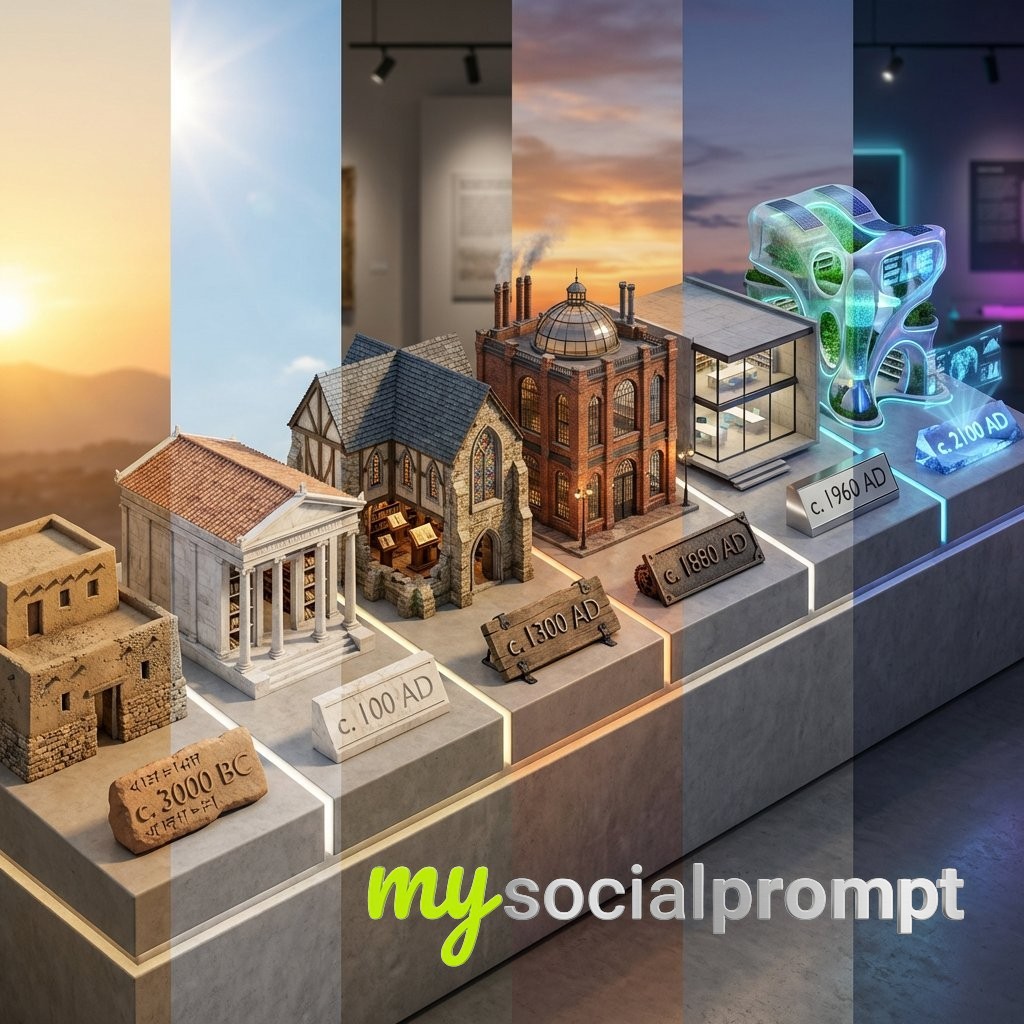
Input Variable A: [libraries] (e.g., Skyscrapers, Bridges, Libraries, Prisons)Input Variable B: [6] (e.g., 3, 5, or 8) System Instruction: Generate a hyper-realistic, 3D "Timeline Diorama" visualizing the evolution of an Architectural Typology. 1. Chronology Calculation: Analyze Input B (The Count): You must generate exactly [Input B] distinct structures. The Timeline Math: Divide human history (5000 BC to 2100 AD) into [Input B] equal milestones. Example (If Input B = 4): Ancient -> Medieval -> Industrial -> Future. Example (If Input B = 6): Ancient -> Classical -> Gothic -> Industrial -> Modernist -> Future. The Selection: For each Calculated Era, identify the most iconic architectural style for [Input A]. 2. Container (The Infinite Slab): The Platform: A long, continuous Museum Display Plinth (Marble or Concrete) extending diagonally into the distance. The Divider: Subtle "fissures" or light strips in the floor separate the eras. 3. Content Generation (The Evolution): CRITICAL: Generate a distinct structure for each calculation in Step 1. Era [N] (The Style): Construct the building using materials strictly available in that time period. Ancient: Mud, Thatch, Rough Stone. Classical/Medieval: Marble, Wood beams, Stained Glass. Industrial: Red Brick, Iron, Soot. Modern: Concrete, Steel, Plate Glass. Future: Bioplastic, Aerogel, Holograms, Greenery. 4. Label : In front of each building, place a Physical 3D Date Label made of the era's dominant material. (e.g., "1920" made of Art Deco Gold; "2050" made of glowing blue Hologram). 5. Visual Syntax: Camera: Isometric or High-Angle Diagonal to fit all [Input B] items in one frame. Scale: Uniform scale. 1:100 Architectural Model style. Atmosphere: The lighting evolves across the image (Sunrise on the left -> Noon -> Sunset -> Neon Night on the right). Output: ONE image, Ultra-Wide Aspect Ratio (21:9 if eras > 4), Architectural Render, Museum Lighting, High Texture Fidelity.
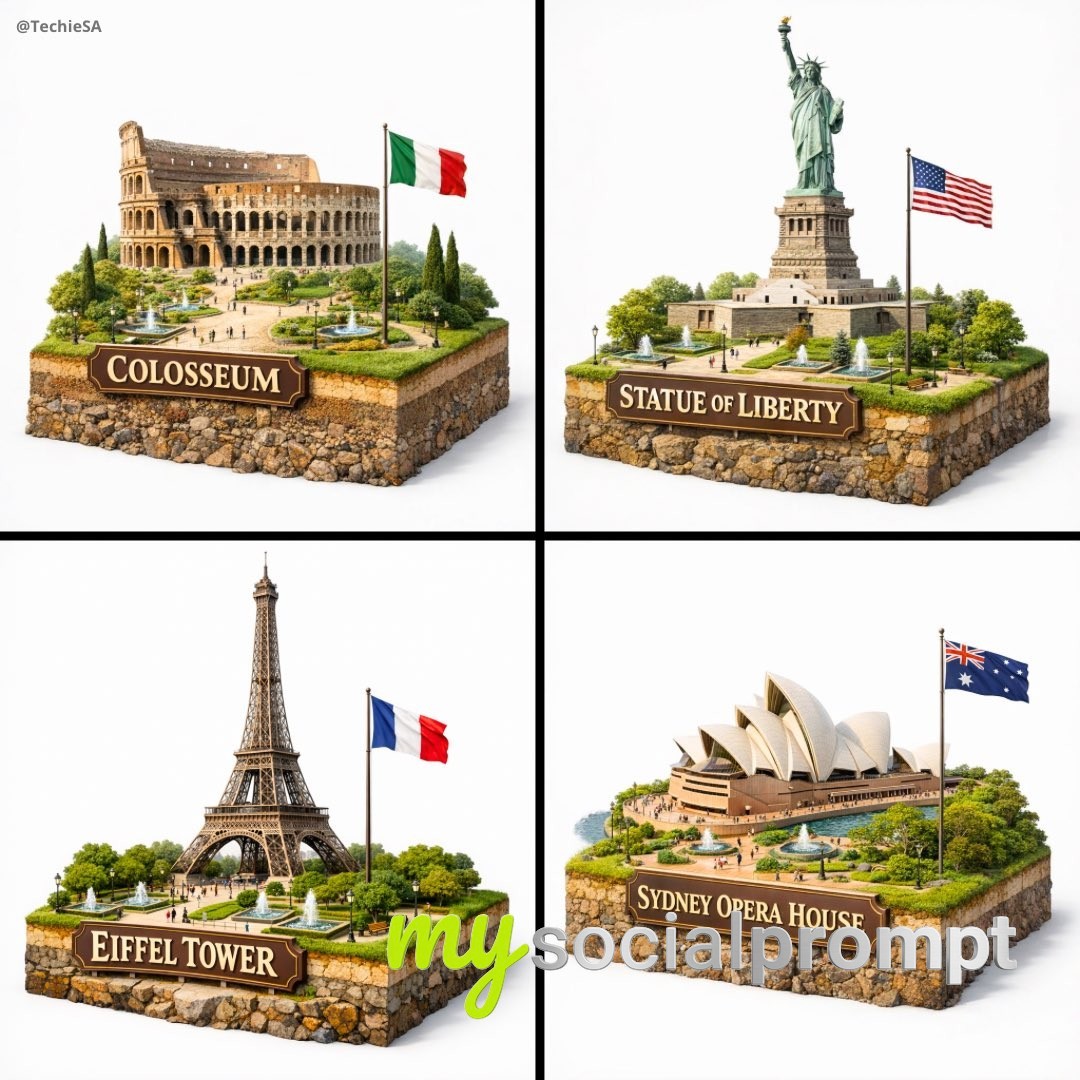
Create a hyper-realistic 3D diorama-style model of [LANDMARK NAME]. The model should appear as a miniature, set on a raised cross-section of earth that reveals soil and rock layers beneath a lush grassy surface. The structure must be highly detailed and proportionally accurate, surrounded by tiny realistic elements like region-appropriate street lamps, native trees, shrubs, water features like small fountains, and historically or culturally fitting pathways. The scene should evoke the unique character of [LANDMARK NAME]’s surrounding landscape. The environment must include a soft white background to draw full attention to the model. Include the text “[LANDMARK NAME]” in large, bold, elegant lettering prominently displayed on a big sign or billboard at the front of the diorama, easily readable and eye-catching, along with a large national flag on a tall, prominent flagpole positioned beside [LANDMARK NAME], clearly visible and waving. 1080x1080 dimension
 1/4
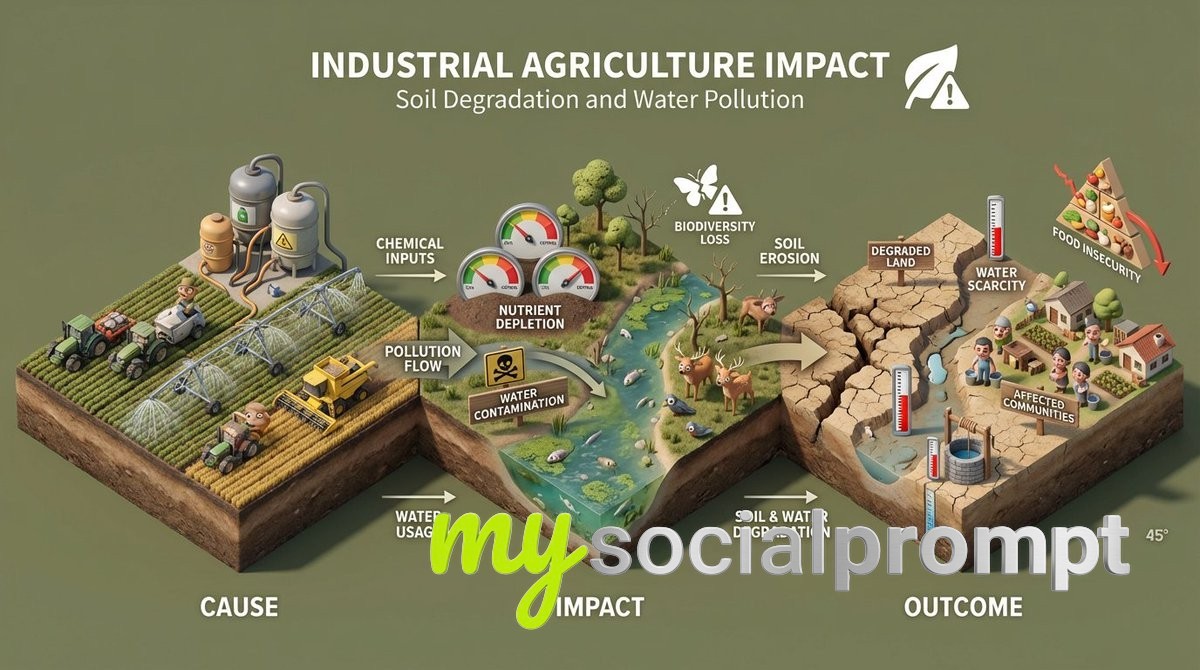
1/4“Build an isometric miniature 3D diorama explaining the environmental impact of [ACTIVITY OR PRODUCT].Viewpoint stays near 45° from above.Textures look realistic and balanced. Lighting feels soft and clear. The raised base splits into cause, impact, and outcome sections. Include visual indicators like meters, symbols, or levels.Tiny stylized figures represent people, wildlife, or infrastructure. Figures have heavy facial details.Background remains solid [BACKGROUND COLOR].Top center text reads [TOPIC NAME] in bold.Subtitle states the key impact in one line. A minimal environment icon appears below. Text switches between white or black for contrast.”
 1/4
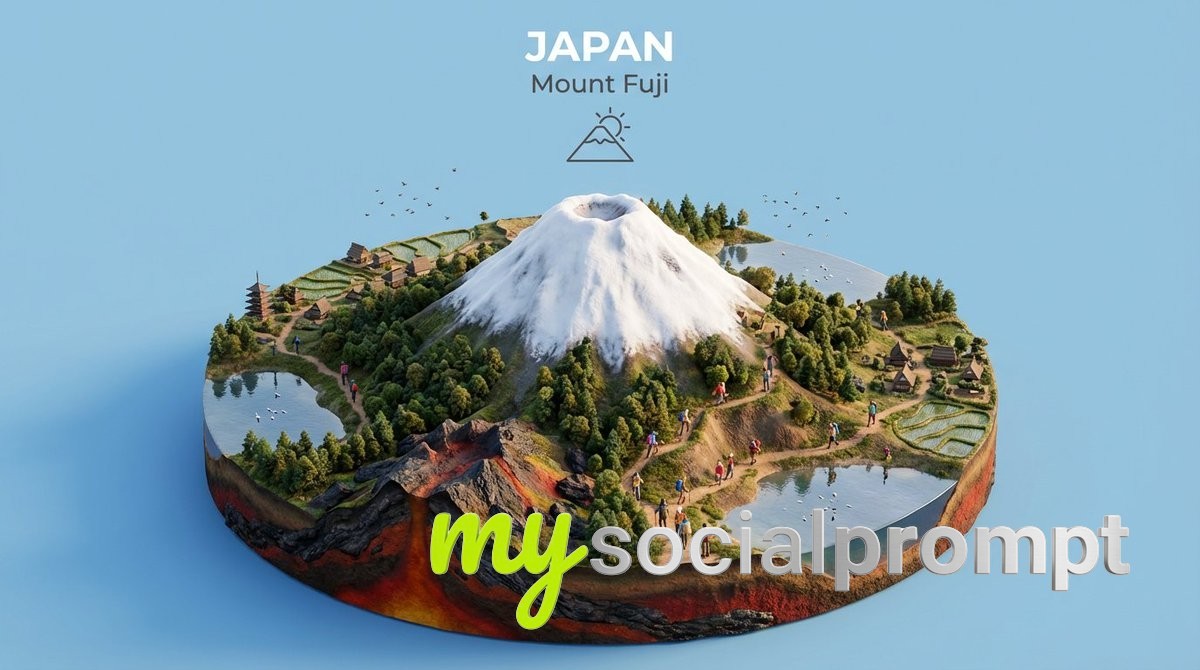
1/4Create an isometric miniature 3D diorama highlighting the natural landmark [NATURAL WONDER] from [COUNTRY NAME/PLANET].Use a 40–45° top-down view. Textures look organic and realistic with PBR materials. Lighting feels soft and atmospheric.The raised base shows terrain layers, vegetation, and surrounding geography. Add tiny stylized explorers or wildlife with no facial details.Background remains solid [BACKGROUND COLOR].Top center text displays [COUNTRY NAME] in bold.Second line shows [NATURAL WONDER]. Place a minimal nature icon below. Text automatically adapts for contrast.
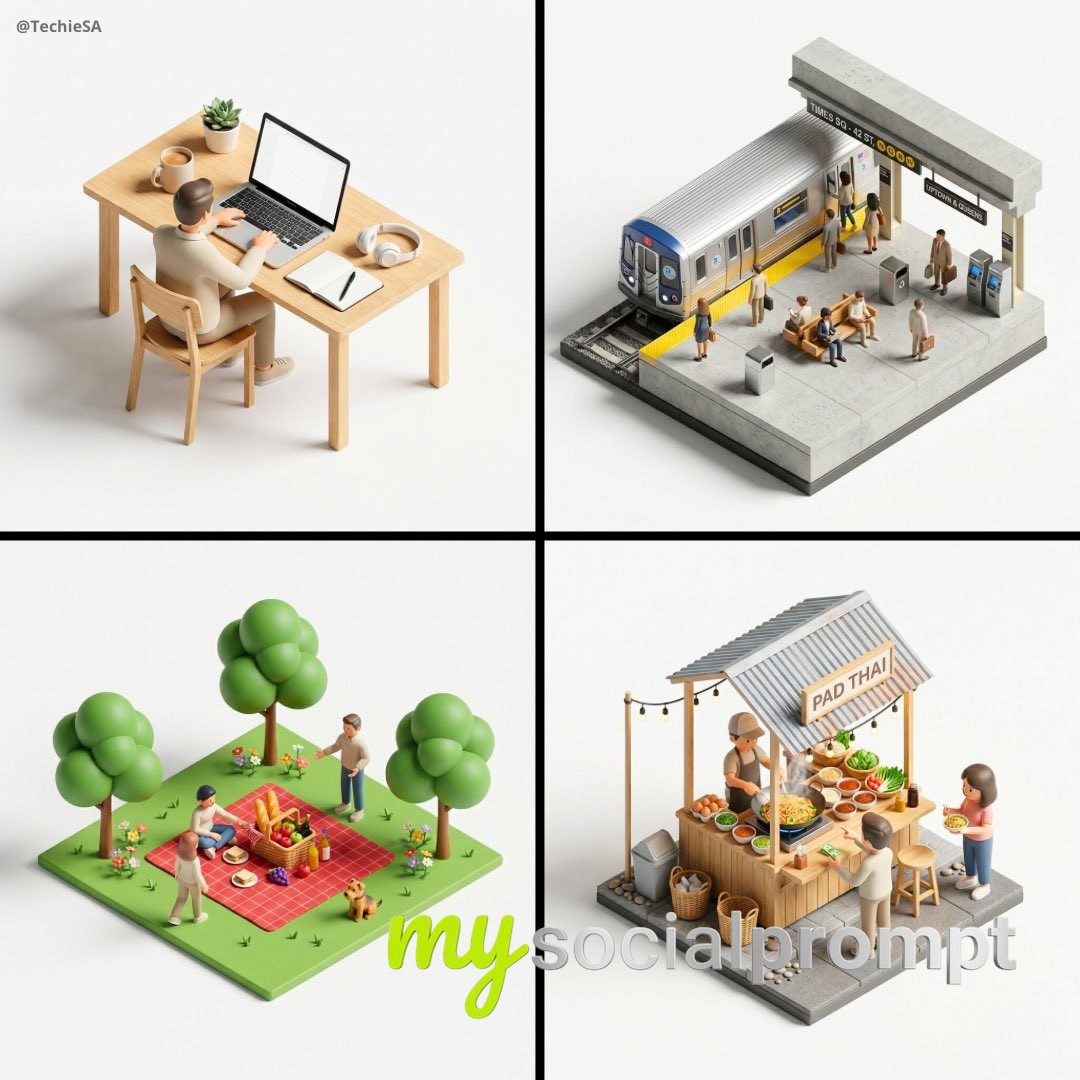
Create a 45° top-down isometric miniature 3D diorama of [SCENE], including all key objects and tiny stylized people interacting naturally with the environment.Composition:•Include all relevant props, furniture, or items that make the scene recognizable.•Tiny characters can sit, stand, walk, or interact with objects as appropriate.•Soft realistic lighting, gentle shadows, subtle textures, minimal background.•Maintain consistent scale, camera angle, perspective, and style.Visual style: clean, editorial Apple-UI aesthetic, bright yet soft colors, ultra-crisp 3D textures.Background: solid color Crisp WhiteOutput: 1080×1080, ultra-crisp, social-feed optimized, no watermark.